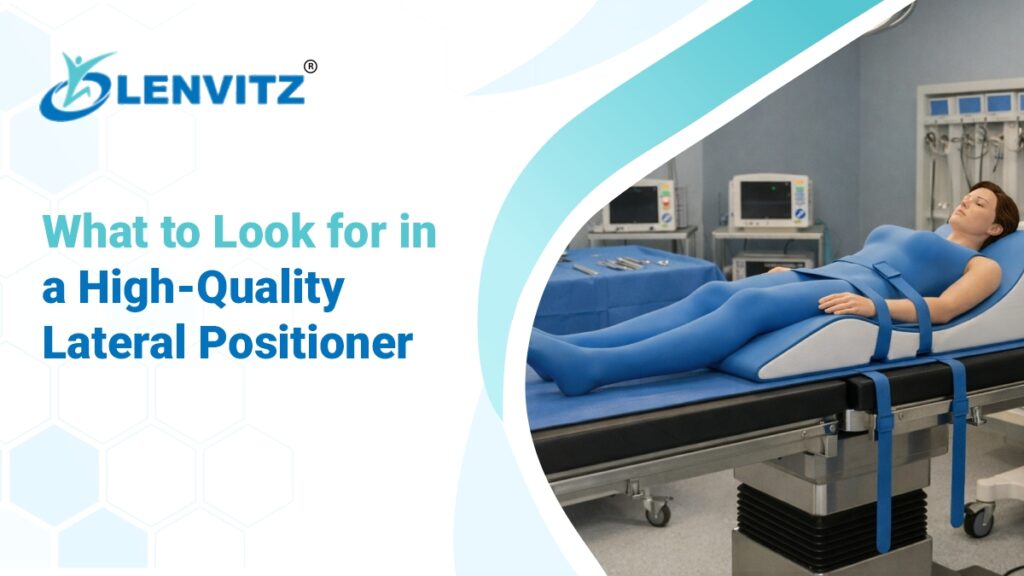

Whether you’re a healthcare professional setting up an operating room or a patient learning about your upcoming procedure, understanding what makes a lateral positioner high-quality is important. The right positioner does more than just hold a patient in place it protects nerves, prevents pressure injuries, and directly impacts surgical outcomes.
This guide takes you through each feature that needs to be considered before deciding on a lateral positioner, such as why silicon gel pads and lateral position gel pads are important elements of any good system.
What Is a Lateral Positioner?
A lateral positioner is a medical piece of equipment that entraps a patient in a side-lying (lateral decubitus) position in the case of surgery or medical treatment. This is mostly applied in orthopedic, thoracic, kidney, and spine as well as hip surgeries, where the surgeon requires direct lateral access to the area of operation.
Correct lateral positioning does not involve merely rolling a patient on his or her side. In the absence of the correct positioner and padding system, patients are at high risk of developing nerve compression, pressure sores, joint damage, and skin injuries. Here, the quality of the lateral positioner (and of gel pads to go with it) is everything.
Why is the Quality of the material the most important?
The material the lateral positioner is made of is the first consideration. This is the only aspect that defines comfort, safety, pressure relief, and duration of the device.
Silicon Gel Pads, Medical Grade
Lateral positioners of high quality incorporate silicon gel pads as their cushioning material. The reason silicone is used in medical devices is that it is called the gold standard because it distributes the pressure uniformly throughout the body, adapts to the unique body shapes, and preserves its functionality during hundreds of surgical procedures.
Pads made of silicon to be used in the lateral position decrease the focal pressure on the bony prominences such as the shoulder, hip, iliac crest, knee, and ankle. The gel spreads the weight of the body over a broad range of contacts instead of the body weight being concentrated at a few body contacts. This significantly reduces the risk of pressure injuries and nerve damage during the long procedures.
What to Avoid
Low-density materials or foam-only are easy to degrade in surgical conditions. They become permanently squashed, reducing their protective features. Porous media are also not easily washed and may have bacteria in between uses, a serious issue in the operating room setting.
Pressure Relief and Patient Safety Features.
An effective lateral positioning device should cushion the patients against the most frequent positioning-related complications. Search: the following characteristics can be found:
Even distribution of pressure – gel pads are supposed to distribute body weight evenly without the formation of concentration on the greater trochanter, shoulder joint, and lateral knee.
Nerve protection – The appropriate padding of the elbow, shoulder, and hip will help decrease the possibility of nerve compressions of the brachial plexus and other nerve compressions that may lead to short-term or long-term weakening.
Anti-slip surface – the positioner should remain permanently in place during the procedure. The least movement during the operation can give a false impression and cause injuries. Quality gel pads have a non-slip bottom that holds the operating table.
Full body coverage Full body lateral positioning system- Full body, torso, inter-leg, between-ankles, and between-knees, arm support, and head support. Special cushioning is required in each zone.
Stability and Adjustability
A lateral positioner cannot tolerate instability. The equipment must be able to support the patient at the right angle and make sure he/she is secure during the entire process, which may take a few hours.
Find those positioners that have fully adjustable posts or supports, which can be put in the exact position. The flexibility of being able to support a range of patient sizes and body types does not sacrifice safety in systems. Positioners in the form of bean bags that shape themselves around the body of the patient are also very effective, especially when used together with silicon gel pads to provide extra pressure relief.
The positioner must avoid rolling both anterior and posterior. The torso and the pelvis require a hard, stable support to ensure that the surgeon will carry out his or her work with certainty and the patient will be safe.
Hygiene and Sterilization Standards
In the operating theatres, cleanliness is all. Only the capacity to be hygienically cleaned with each use renders a lateral positioner effective.
Select gel pads that have smooth, non-porous surfaces that can be wiped with common surgical disinfectants. Seams and crevices are traps for bacteria and are to be avoided. Its outer cover must be designed out of medical-grade PVC or other such substances, which do not degrade upon repeated cleaning.
Numerous quality lateral position gel pads are also autoclavable, so that they can survive sterilization by steam. This is a great benefit in high-throughput surgical theatres where machines are utilized several times in a day.
It is also important that it will be latex-free. Latex sensitivities are common to many patients and healthcare personnel; latex-free products are now becoming a standard requirement of any quality medical positioner.
Size, Shape, and Compatibility
Lateral positioners are not all created equally. What is a perfect positioner with one patient can be a poor positioner with another. Look for:
Various size selections – There are vastly different needs of pediatrics as compared to adults. Good manufacturers provide a range of sizes so that they can support the appropriate patients.
Procedure-specific shapes- Lateral position gel pads are available in special shapes that are specific to hip surgery, thoracic surgery, and spinal access. Positioning accuracy is enhanced, and patient protection is increased with the appropriate shape of the specific procedure.
Operating Table Compatibility- make sure that the positioner is compatible with your particular surgical table system. A few positioners are made to be incorporated with table-mounted frames, such as the McGuire Hip Positioner system, but others are freestanding.
X-Ray Transparency and MRI Safety
The positioner should not obstruct the equipment where intraoperative imaging is involved in the procedure. Good gel pads are usually X-ray transparent, i.e., they do not block imaging without the repositioning of the patient.
In the case of operations using MRI, ensure that the positioner is MRI-safe. Medical gel positioners usually do not have any conductive materials or metals, and are non-conductive; however, it is always necessary to check with the manufacturer before using them in a magnetic field.
Durability and Long-Term Value
A good lateral positioner is an investment that pays in the long run. A good silicon gel pad that is of medical grade, well taken care of, and cleaned can be used for a number of years under daily surgical operation and retain its properties of cushioning and structural integrity.
Considering alternatives, do not focus only on the initial price, but also on the overall cost over time. An inexpensive positioner that must be replaced regularly and endangers patient safety or causes positioning-related issues is much more expensive than making an initial investment in quality.
Find manufacturers that provide clear information on the product life cycle, the number of sterilization cycles, and the warranty.
Read More: Top Benefits of Lateral Position Gel Pads: Comfort & Pressure Injury Prevention
Frequently Asked Questions (FAQs)
Silicon gel pads stay softer and more responsive over hundreds of uses, while foam compresses and loses its protective shape over time. Gel also spreads pressure more evenly, which is critical for protecting nerves and skin during long surgeries. For lateral positioning specifically, gel pads hold their form against bony prominences much better than foam alternatives.
Yes, ideally. A complete lateral positioning system uses dedicated lateral position gel pads for different zones — the torso, between the knees, under the ankle, and beneath the dependent arm. Each area has different pressure and support needs, and purpose-shaped pads do a much better job than placing a single generic pad under the whole body.
With proper care and regular sterilization, high-quality silicon gel pads can last several years. Signs it’s time to replace them include visible tearing or surface damage, permanent compression (the pad no longer returns to its original shape), or discoloration that won’t clean off. Always follow the manufacturer’s guidance on maximum sterilization cycles.
Absolutely — this is actually one of the key benefits of quality gel pads. Elderly patients or those with thin, fragile skin benefit greatly from gel because it reduces friction and shear forces that can cause skin tears. Silicon gel pads are also typically hypoallergenic and latex-free, making them safe for patients with sensitivities.
It depends on the system. Some lateral positioners are universal and work across multiple procedure types, while others are designed for specific surgeries like hip replacement or thoracic access. Adjustable post-based systems offer the most flexibility. For procedure-specific needs, having dedicated lateral position gel pads in the correct shapes improves safety and positioning accuracy.