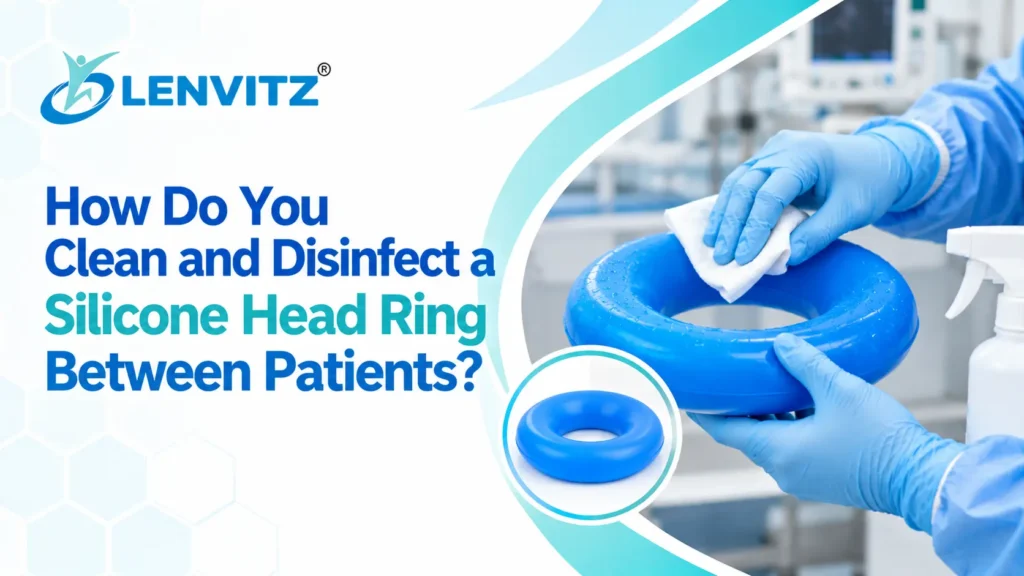
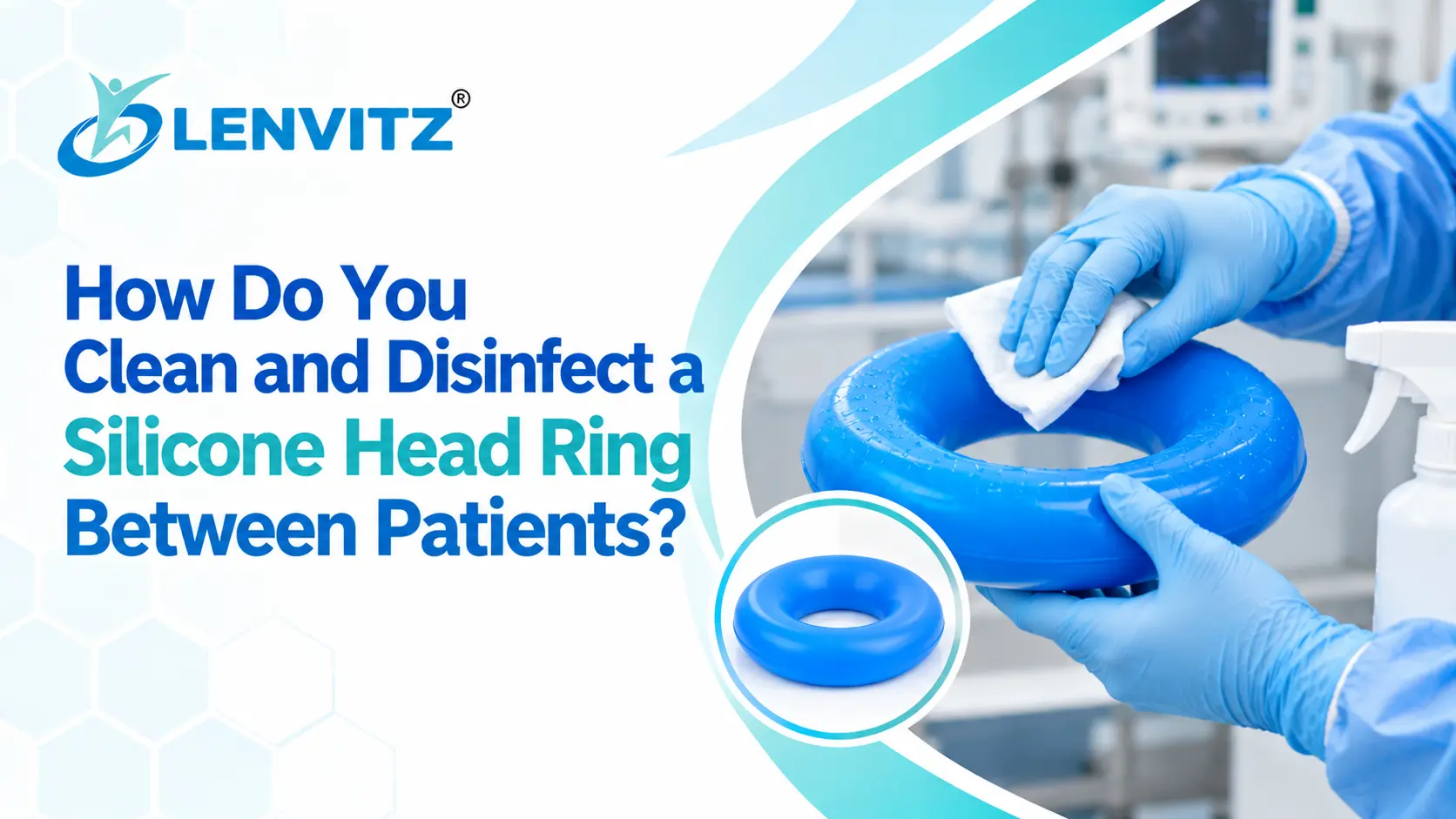
To clean and disinfect a silicone head ring between patients, remove it from the table, wipe off all visible soil with a detergent or a disinfectant wipe, apply a hospital-grade disinfectant for its full label contact time, rinse if the label requires it, dry the ring, and inspect it for damage before reuse. Always follow the manufacturer’s written instructions and your facility’s policy.
Why a head ring needs cleaning after every patient
A silicone head ring sits under the head for the length of the case. It collects sweat, skin oils, prep solution, hair and, at times, blood or other body fluid. The next patient’s head will rest on the same surface, so the ring has to be clean before that happens.
Silicone helps. A smooth, non-porous surface is easier to wipe than fabric or open foam, and Lenvitz Medical Solutions describes its surgical silicone as leak-proof and able to be disinfected between uses. But a surface that is easy to clean still has to be cleaned, and it still has to be cleaned the right way.
Cleaning and disinfecting are two different steps
Staff often use the two words as if they mean the same thing, and that is where head ring cleaning goes wrong. Cleaning removes visible soil and organic matter, using detergent, water and friction. Disinfecting kills most microorganisms on a surface that has already been cleaned. A disinfectant sprayed on top of dried residue has to work through a layer of soil, and soil can shield microbes from it.
So the order matters. Clean first, then disinfect, and treat them as two actions even when a single wipe is labelled to do both. If you use a combined detergent and disinfectant wipe, the first pass removes the soil and a second pass applies the disinfectant for the full contact time.
How often should a head ring be cleaned?
After every patient, before the next one lies on it. The CDC guideline says to disinfect noncritical equipment when it is visibly soiled and on a regular schedule, such as after each patient, daily or weekly, depending on the item. For a ring that rests directly under the head, the sensible schedule is after each patient, with a closer look whenever the case involved blood, prep solution or heavy sweating.
Rings that stay on a table all day without being wiped between cases are the usual source of problems. Make the check part of the room turnover so it does not rely on anyone remembering.
What level of disinfection does a head ring need?
Infection control guidance groups patient-care items by the risk they carry. A head ring touches the patient’s intact skin, so it falls into the noncritical category. Intact skin is an effective barrier against most microorganisms, which means sterilisation is not required for these items. Low-level disinfection is enough.
The CDC guideline says to use an EPA-registered hospital disinfectant for noncritical items and to follow the label directions. Indian facilities will have their own approved product list and policy, so use whatever your infection control team has approved. The principle is the same: a hospital-grade disinfectant used as the label directs, not an improvised solution.
Two exceptions change the plan. If a ring contacts non-intact skin, for example in head or facial trauma with open wounds, check your policy because a higher level of disinfection may be required. If it is contaminated with blood, follow the blood spill steps below.
Step by step: how to clean and disinfect a silicone head ring
These steps suit most reusable silicone rings, and they apply to any routine for how to disinfect a silicone head ring between cases. Where your manufacturer’s instructions differ, follow the manufacturer.
- Put on gloves and any PPE your policy requires, then remove the ring from the table without dragging it across the surface.
- Remove visible soil first. Wipe off blood, prep solution, gel or other residue with a disposable cloth, a detergent wipe or a disinfectant wipe. Clean as soon as practical after use, because dried material is harder to remove and reduces how well disinfectants work.
- Wash the whole surface, including the inner edge of the opening, the underside and any seams. These are the places that get missed.
- Apply the disinfectant that your facility has approved and the manufacturer allows. Keep the surface visibly wet for the full contact time printed on the label.
- Rinse if the label says to, and rinse thoroughly. Residue left on the surface can interfere with disinfection and can irritate skin.
- Dry the ring completely with a clean, lint-free cloth or let it air dry in a clean area. Trapped moisture under a patient’s head adds to the risk of skin breakdown.
- Inspect it under good light for cuts, cracks, tackiness or flattening, then store it in a clean, dry place.
What contact time should you use?
Follow the label. Many EPA-registered disinfectants state a 10-minute contact time. The CDC guideline notes that some have shown activity in 30 to 60 seconds in studies, but it does not present that as a substitute for the label, and it says that federal law requires users to follow label instructions, including dilution and material compatibility. Someone who chooses a shorter time takes on the risk.
If the printed time is too slow for a busy list, the fix is a different approved product, not a shorter wipe. Ask your infection control team which product suits your turnover.
When the ring has blood or body fluid on it
Blood changes the routine. Clean and decontaminate promptly, wear gloves and the PPE your policy requires, and remove large amounts of visible matter with disposable absorbent material before you wipe. For blood spills on surfaces, the CDC guideline calls for an EPA-registered tuberculocidal agent or a hypochlorite solution, with a more concentrated first application for large spills and terminal disinfection afterward.
Check that your disinfectant suits the ring’s material before using a stronger agent. A ring that cannot be cleaned properly after contamination should not go back into use. The CDC guideline is direct on this point: items that cannot be properly cleaned or disinfected should be repaired or discarded.
Patients on contact precautions
Where disposable equipment is not available, noncritical equipment used on a patient on contact precautions should be disinfected after use and before it goes to another patient. For a head ring, that means treating it as contaminated from the moment it leaves the table. Some units keep a single-use or dedicated ring for these patients so that the reusable stock stays out of the way. Your policy decides which approach applies.
Mistakes that damage the ring or undermine disinfection
- Using an unapproved product. A disinfectant the manufacturer has not cleared can harden, cloud or crack the surface, and a damaged surface holds soil.
- Skipping the cleaning step. Soil shields microbes from disinfectants, so spraying over visible residue does not work.
- Cutting the contact time. A wipe that dries in seconds has not met a label that asks for minutes.
- Using abrasive pads or sharp tools. Scratches give soil somewhere to settle.
- Autoclaving without checking. Some devices suit autoclaves better than others, so only use heat processes the manufacturer allows.
- Storing it damp, or stacking heavy items on it.
Inspect before reuse, and know when to retire the ring
Cleaning and inspection belong together. Look for cuts, cracks, a sticky or tacky surface, flattening that no longer springs back, leaking, and stains that do not wipe off. A ring that cannot be cleaned is an infection control problem, and one that has flattened no longer protects the patient’s head from pressure. Remove it from circulation, record why, and replace it.
Reusable devices also have a limited number of uses, and the supplier or the instructions for use should state it. Mark each ring with a use count and check it at every cleaning.
Build the routine into a written protocol
A good method fails if nobody follows it, so write it down. A one-page protocol should name the approved disinfectant, the contact time, who cleans the ring and where, and how damaged rings are reported. Keep a copy where reprocessing staff and circulating nurses can read it, and repeat the training when you change products or suppliers.
What to ask a supplier
Before buying head rings, ask for the manufacturer’s written cleaning and disinfection instructions, the disinfectants they approve, whether any heat processing is allowed, the expected number of uses, and the sizes available for adult and paediatric patients. Lenvitz Medical Solutions, a Pune manufacturer, makes silicone gel positioning products in adult, paediatric and neonatal ranges. Ask for its cleaning guidance in writing and match it to the products your infection control team already approves.
FAQ’s
Remove visible soil with a detergent or disinfectant wipe, apply an approved hospital disinfectant for the full label contact time, rinse if the label requires it, dry the ring and inspect it. Follow the manufacturer’s instructions and your facility’s policy.
No. Cleaning removes visible soil and organic matter. Disinfecting then kills most microorganisms on the cleaned surface. Clean first, because soil can shield microbes from the disinfectant.
A head ring touches intact skin, so it is a noncritical item and low-level disinfection is enough. Use an EPA-registered or locally approved hospital disinfectant as the label directs. If the ring touches non-intact skin, check your policy.
After every patient, before the next patient lies on it. Add a closer check whenever the case involved blood, prep solution or heavy sweating.
Replace it when it is cut, cracked, leaking, sticky, flattened or stained beyond cleaning, or when it reaches the use limit the manufacturer states. A ring that cannot be cleaned should come out of service.