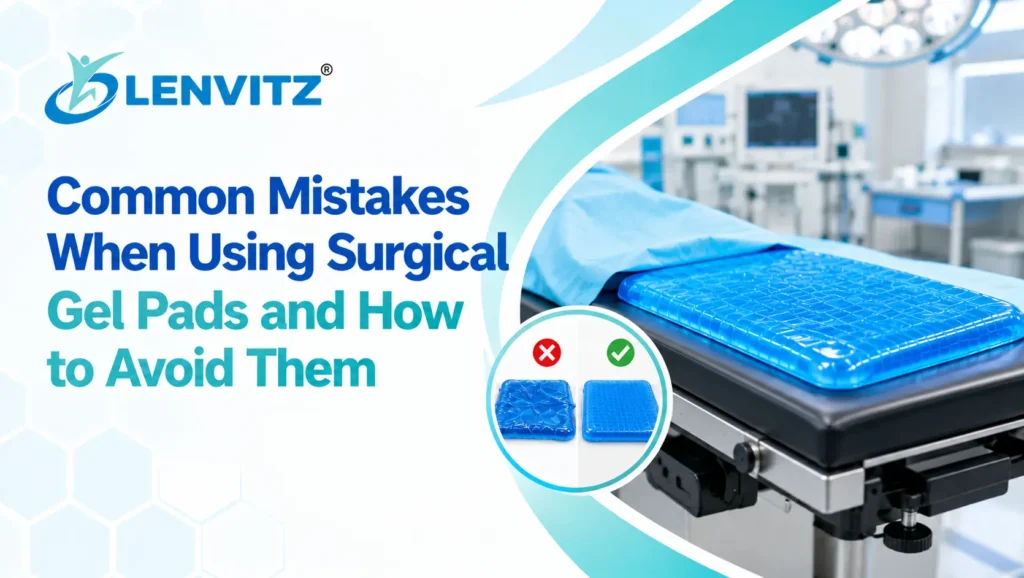
A good pad can still fail the patient. Most problems with gel pads in the OT come from how they are chosen, placed, cleaned and rechecked, and very few come from the gel itself. The eight mistakes below are easy to make on a busy list, and each one has a simple fix that any theatre team can adopt.
What surgical gel pads do, and where they stop
Gel behaves like a thick fluid under load. It flows around bony points, increases the contact area and lowers peak pressure and shear. That is the job of pressure relieving gel pads, and the reason patient positioning gel pads appear in most OT protocols for supine, lateral, prone and lithotomy cases.
Two gel formulations dominate the market. Silicone gel pads are made from 100% silicone gel, and buyers who search for silicon gel pads are usually looking for the same product under a common misspelling. Memory gel is the other option. Lenvitz Medical Solutions, a Pune manufacturer, makes both and describes them as almost equally effective at relieving pressure. It also makes gel and foam combinations that handle more easily in the OT and cost less.
The pad is one layer of protection. AORN guidance treats every perioperative patient as at risk, because they lie still on a firm surface and cannot feel or react to pressure under anaesthesia. A pad lowers that risk only when it is used well.
Mistake 1: Choosing pads on price alone
A pad that is too small leaves the patient’s weight on its edges. One that is too thin bottoms out under a heavy patient. A shape built for supine cases may do little in lateral or lithotomy.
AORN’s buying advice for positioning devices is practical. Contact facilities that already use the product, review the injury evidence, and involve surgeons, nurses, surgical techs and finance in the trial. If you handle paediatric or neonatal cases, confirm the range covers them, because adult pads cut down or stacked for a small patient do not distribute pressure the same way.
Ask suppliers for sample pads so surgeons and nurses can judge thickness, handling and fit on your own tables.
How to avoid it: list your procedure mix first, then trial patient positioning gel pads against it before you place a bulk order.
Mistake 2: Putting extra layers between the pad and the patient
This one is common and often well meant. A folded blanket, a second sheet or a layer of foam goes down “for comfort” or to catch fluid. AORN describes extra layers between a gel pad and the patient as a frequent misuse, usually caused by gaps in training, and notes that the patient should typically lie directly on the pad.
Extra layers reduce the contact the gel needs to do its work. They also wrinkle, and a ridge of linen under a sacrum or heel concentrates pressure at exactly the wrong spot.
How to avoid it: follow the manufacturer’s instructions on what may go between pad and patient. Where a single sheet is part of your policy, pull it flat before transfer.
Mistake 3: Treating the pad as the whole plan
Heels show the problem best. A flat pad or egg-crate foam under the heels does not offload them. AORN recommends a boot-style heel suspension device that lifts the heels off the surface and spreads leg weight along the calf, with the knees flexed about 5 to 10 degrees.
Sacral protection works the same way. AORN also recommends prophylactic dressings on bony areas such as the heels and sacrum for high-risk patients, alongside a surface that redistributes pressure. The Braden Scale falls short for surgical patients, so use a risk tool built for the perioperative setting.
How to avoid it: treat pressure relieving gel pads as the support surface, then add heel offloading, dressings and a risk assessment on top.
Mistake 4: Poor placement, or letting the pad shift
A pad whose edge sits under a bony point does little good. Pads also move. Transfer from trolley to table, a head-down tilt or the shift into lithotomy can slide a pad or the patient across it, and sliding adds shear. In lithotomy, weight moves toward the sacrum and coccyx, so a pad there needs a second look once the legs are up.
How to avoid it: place pads on the table before transfer, centre them under the area they protect, and recheck after final positioning and after any table movement. A pad works only where the body actually rests on it.
Mistake 5: Ignoring heat and moisture
Moisture raises the risk of skin breakdown. AORN notes that heavy vinyl-type materials can trap heat and cause sweating, and that warming devices can make it worse. Prep solution that pools under the patient, or linen that gets wet during the case, adds to the same problem.
Allergy matters here too. Check the patient’s allergies against the pad and cover materials before the case begins.
How to avoid it: keep the skin under the pad dry, stop prep fluid from running beneath the patient, and replace wet linen when you can do it safely.
Mistake 6: Cleaning with the wrong product, or skipping it
Cleaning and setup should follow the manufacturer’s instructions. Some devices suit small soak sinks and autoclaves better than others, which matters when sterile processing space is tight. A disinfectant the maker has not approved can damage a surface that looks fine until it fails. Pads that touch skin are reprocessed between patients, so cleaning is also an infection control step.
How to avoid it: ask your supplier for written cleaning guidance before you buy, and keep it where the staff who clean the pads can find it. Match it to the disinfectants your infection control team already approves.
Mistake 7: Using worn pads past their service life
Reusable devices have a limited number of uses, and the vendor or manual should state it. A pad that is torn, leaking, flattened, sticky or discoloured gives false reassurance, because it looks like protection and no longer behaves like it.
Storage plays a part. AORN suggests capping sharp shelf edges and using rolling carts so staff handle pads gently and the pads last longer.
Mark the purchase date on each pad so its age is visible at a glance.
How to avoid it: log the use count on each pad, inspect it at every cleaning, and retire it when it shows damage or reaches the limit your manufacturer gives.
Mistake 8: Skipping rechecks and training
Positions change during a case. Arms move, the table tilts, drapes tighten and the surgical team leans in. A setup that was correct at incision can be wrong an hour later.
Staff knowledge drifts too. AORN says ongoing education and periodic retraining on the manufacturer’s instructions help prevent misuse, and that a device used improperly can become dangerous.
A short refresher at the start of a list takes a few minutes and keeps the manufacturer’s instructions in front of the whole team.
How to avoid it: build a recheck into long cases, tell the surgeon when a position needs to change, document the gel pads and positions used, and pass them on at handover so recovery staff know which areas to inspect.
Why these mistakes go unnoticed
Pressure injuries from positioning rarely show up in theatre. In one Brazilian study, 37.7% of surgical patients developed a positioning-related injury, most of them stage 1, and the sacrum and heels were the most frequent sites. Because skin changes appear later, the team that placed the pad seldom sees the result. That distance makes routine checks the main safeguard, and it is why silicone gel pads and every other positioning device need a written routine around them.
A short checklist before incision
- Confirm the pad size and type suit the procedure and the patient.
- Place the pad before transfer and smooth the surface it sits on.
- Keep unnecessary layers out from between the pad and the patient.
- Float the heels and protect the sacrum for high-risk patients.
- Check that the skin and linen under the patient are dry.
- Recheck every pressure point after final positioning.
Choosing a supplier that supports your OT
A pad is only as good as the support around it. Ask any supplier for size ranges, material details, cleaning instructions and the expected number of uses before you commit. Lenvitz Medical Solutions manufactures gel positioning products for supine, prone and lithotomy procedures in adult, paediatric and neonatal sizes, and can advise on the right pad for your procedure mix.
FAQ’s
Surgical gel pads support and cushion a patient on the OT table. The gel flows around bony areas, increases contact area and lowers peak pressure and shear during procedures.
Lenvitz Medical Solutions describes its silicone gel and proprietary memory gel as almost equally effective at relieving pressure. Handling, weight, cleaning needs and budget usually decide the choice.
Patient positioning gel pads are gel-based devices shaped for specific areas and positions, such as head, back, arms, sacrum and heels. Teams use them in supine, lateral, prone and lithotomy cases.
Placing extra layers between the pad and the patient is a frequent misuse, according to AORN, and it usually comes from gaps in training. Patients should typically lie directly on the pad.
Reusable devices have a limited number of uses, and the manufacturer should state the limit. Retire any pad that is torn, leaking, flattened or sticky, whatever its use count.
Yes. Lenvitz gel products come in adult, paediatric and neonatal ranges, so smaller patients are positioned on pads sized for them.