An anaesthetised patient cannot say that their arm hurts. For the next hour or four, whatever the team sets up on the table is what the nerves have to live with. The brachial plexus is one of the most commonly injured structures in surgical positioning, and arm placement drives most of that risk. An arm rest gel pad is among the simplest tools in the setup, but it protects the nerve only when the angle, alignment and checks around it are right.
This guide explains where the plexus is vulnerable, which arm positions put it at risk, and what an arm rest gel pad can and cannot do.
Why the brachial plexus is easy to injure
The brachial plexus is the network of nerves that runs from the spine, between the first rib and the collarbone, out to the shoulder, arm and hand. It sits close to bone and has little soft tissue around it. That has two consequences on the OT table.
First, it can be compressed. Bone presses on it from nearby, and so can devices placed near the shoulder, such as shoulder braces. Second, it can be stretched or twisted when the arm is held in an unnatural position, because the nerve is anchored at the neck and carried along with the limb.
An awake patient fixes both problems without thinking, by shifting or complaining. Under anaesthesia the patient cannot do either, so the team has to prevent the forces before they build. Time makes it worse. A position that causes no harm for 30 minutes can injure a nerve over a long case.
Arm positions that raise the risk
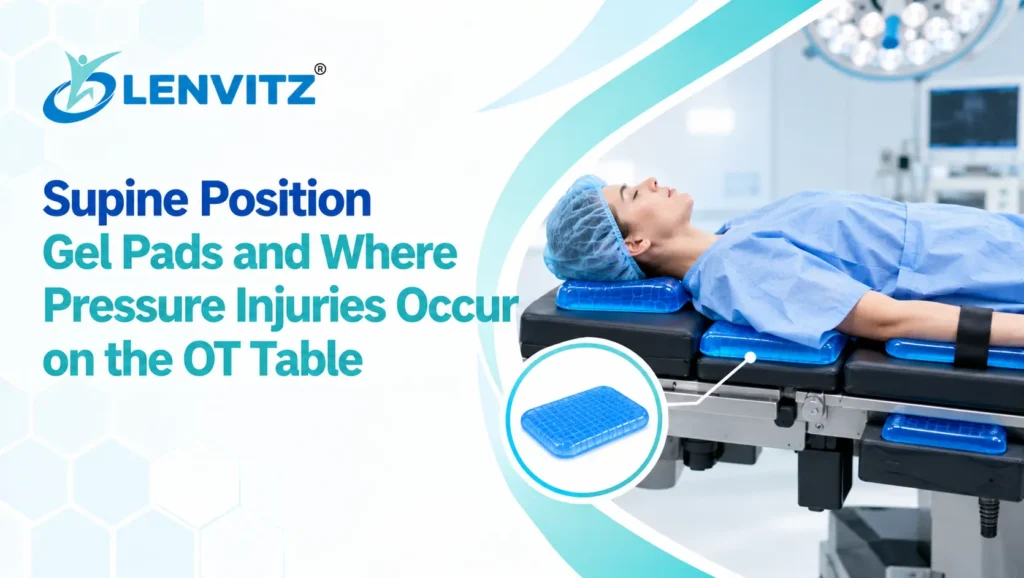
In the supine position, the risk rises when the arms are extended beyond 90 degrees from the body, or rotated with the palms facing down. Both stretch the plexus. Guidance for supine cases is to keep the arm at or below 90 degrees, supported and secured on the arm board, with the palm up and the fingers extended.
The head matters as much as the arm. Extreme head rotation away from the arm adds stretch on that side, so the head should stay aligned with the neck and face upward rather than turned. In the beach chair position, a roll under the neck helps prevent hyperextension, and padding behind the non-operative shoulder relieves stretch on that side.
Other positions bring their own hazards:
- Trendelenburg: shoulder braces used to stop the patient sliding can compress the plexus, so they are discouraged. Viscoelastic gel, convoluted foam and vacuum-packed devices are the usual alternatives.
- Prone and lateral: arms are often raised or tucked forward, which makes angle and support easy to get wrong.
- Beach chair: the non-operative arm should rest neutral, with the elbow bent at about 90 degrees and padding in place. Poor padding here has been linked to ulnar nerve damage with lasting pain.
Staff behaviour is a risk too. A surgeon or assistant leaning on the patient’s arm can cause an injury that no pad will prevent, which is why anyone on the team should feel free to speak up.
What an arm rest gel pad does
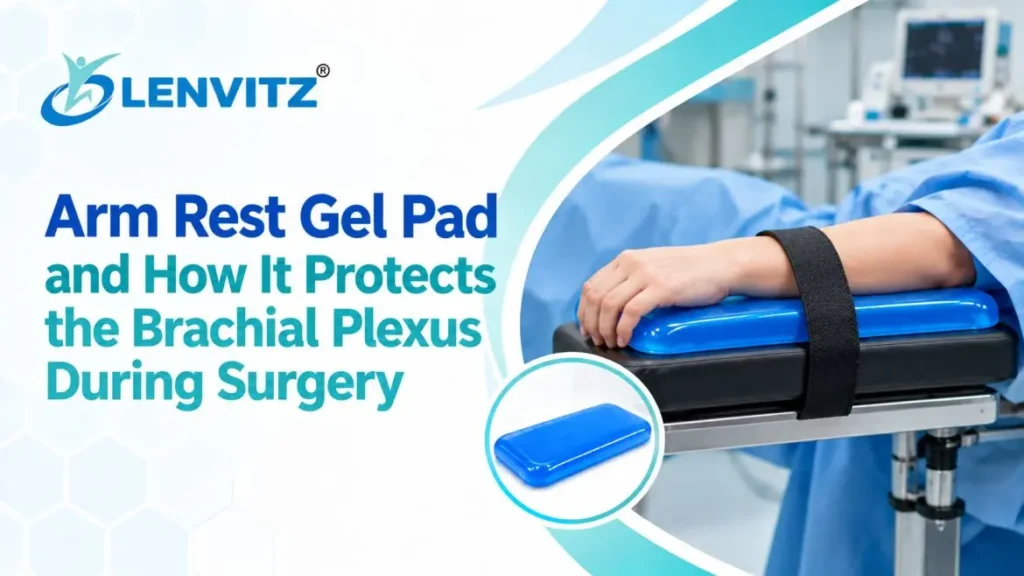
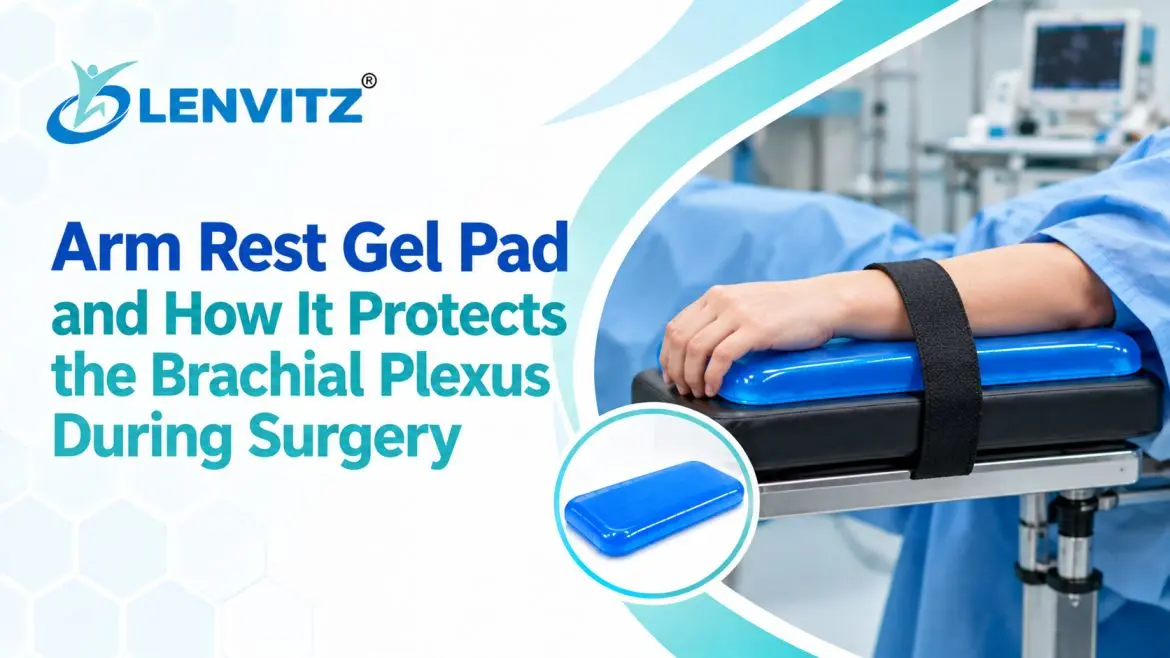
Gel pads work as a thick fluid under load. They flow around the arm, increase the contact area and lower the peak pressure and shear at each point. On an arm board, an arm rest gel pad cushions the forearm, elbow and the back of the upper arm, which are the places where the ulnar nerve and soft tissue take direct pressure against a hard board.
The elbow deserves special attention. The ulnar nerve runs close to the surface there, so a thin or worn pad lets the bony point press against the board. A pad with enough thickness at the elbow spreads that load, and an extra elbow pad can cover the gap when the main pad does not reach.
Be exact about its role. The pad protects the arm from pressure and supports it comfortably. It does not set the angle. If the arm is abducted past 90 degrees or rotated palm down, the plexus is stretched whatever sits underneath it. The pad is the support surface, and the team still has to set the position.
That is why guidance for positioning usually pairs padding with alignment. Pad the head, shoulders and elbows, secure the arm so it cannot slide off the board, and use the gel to keep the load spread rather than to hold a bad position in place.
How the pad fits into a supine arm set-up
A sound set-up follows a short order. Placing the pad first and adjusting everything else around it saves rework.
- Fit the arm board and arm rest gel pad to the table before the patient is transferred, and smooth the surface so no linen ridge sits under the arm.
- Place the arm on the board at or below 90 degrees, palm up, fingers extended, and secure it so it cannot drift.
- Check that the head is aligned with the neck and not turned hard toward or away from either arm.
- Pad the elbow and any other pressure point the pad does not cover.
- Recheck after the final position is set, after any table tilt, and after drapes go on.
Drapes deserve a note of their own. Hyperextension and slipped arms can be hidden under them, so look underneath after repositioning rather than assuming the setup held.
Children need their own approach. For paediatric patients the arms may rest alongside the body with the palms facing the body, held by safety straps, and the draw sheet should be tucked under the patient rather than the mattress to avoid pressure on nerves and circulation. Pads sized for small arms matter here, because an adult pad cut down or stacked does not spread load the same way.
Long cases and changing positions
Positions drift. Table tilts, drape tension and a team leaning in all move a limb that was correct at incision. One published source suggests a neutral-position break about every 15 minutes in long cases, and your own policy may set a different interval. Whatever the number, build a scheduled recheck into the case and write down every positioning change and extra device used.
Documentation also helps the recovery team. If they know how the arms were placed and for how long, they know where to look for weakness, numbness or tingling in the hours after surgery.
Silicone gel, memory gel and what to ask a supplier
Two gel types dominate the market. Silicone gel pads are made from 100% silicone gel. Many buyers search for silicon gel pads, which is the same product under a common misspelling, since silicon is the chemical element and silicone is the polymer. Memory gel is the other option. Lenvitz Medical Solutions, a Pune manufacturer, makes both, describes them as almost equally effective at relieving pressure, and also supplies gel and foam combinations that are easier to handle and lower in cost.
When you compare gel pads for arm support, ask a supplier for these details:
- the sizes available for your arm boards, including paediatric and neonatal ranges
- the gel types and the thickness of each pad
- written cleaning and disinfection instructions that match your infection control policy
- the expected number of uses, and how to tell when a pad has worn out
Material also affects comfort. Heavy vinyl-type covers can trap heat and cause sweating, and moisture raises the risk of skin breakdown. Check patient allergies against the pad materials before the case.
Signs a pad should be retired
A torn, leaking, flattened or sticky pad gives false reassurance. It looks like protection and no longer behaves like it. Inspect every pad at cleaning, record how many times it has been used, and take it out of circulation once it shows damage or reaches the limit set by the manufacturer.
Putting it together
The brachial plexus is protected by position first and padding second. Keep the arm at or below 90 degrees, align the head, avoid shoulder braces, and recheck through long cases. Then give the arm a good support surface with a well-chosen arm rest gel pad. Lenvitz Medical Solutions makes gel positioning products for supine, prone and lithotomy procedures in adult, paediatric and neonatal sizes, and can advise on arm board pads for your procedure mix.
FAQ’s
An arm rest gel pad is a gel-filled pad placed on an arm board to cushion the forearm, elbow and upper arm during surgery. It spreads pressure over a larger area and reduces shear against the hard board.
The brachial plexus is the network of nerves that runs from the spine, between the first rib and the collarbone, to the shoulder, arm and hand. It lies close to bone, which makes it easy to compress or stretch.
It happens when the nerve is compressed, for example by shoulder braces, or stretched and twisted by an arm held in an unnatural position. Anaesthetised patients cannot signal discomfort, so the team must prevent these forces.
No. The pad cushions the arm, but it does not set the angle. If the arm is extended beyond 90 degrees or rotated palm down, the plexus is stretched whatever pad is underneath.
Yes. Lenvitz gel products come in adult, paediatric and neonatal ranges, so smaller arms can rest on pads sized for them rather than on adult pads cut down or stacked.