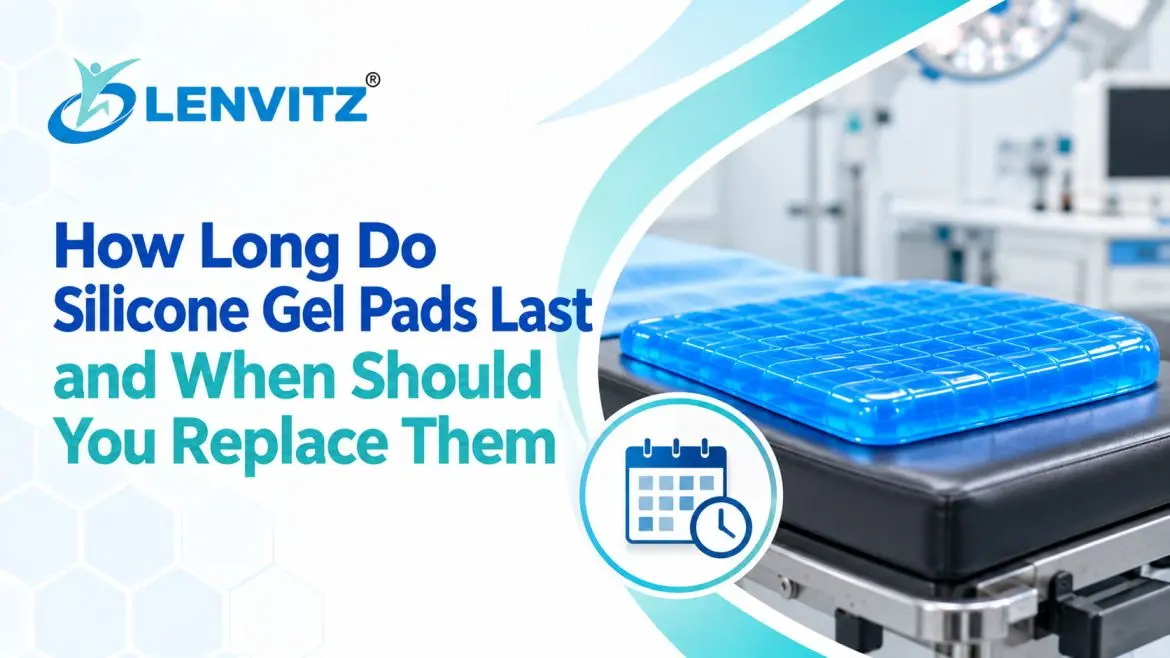
There is no single number that fits every OT. How long silicone gel pads last depends on how often they are used, how they are cleaned, how heavy the patients are and how they are stored. A pad used twice a week and wiped with the right disinfectant can outlast one used six times a day and handled roughly. What matters is knowing the signs of wear and having a routine that catches them before a patient is on the table.
This guide covers what shortens a pad’s life, the signs that mean it should go, and how to build a replacement routine your team can follow.
Why a calendar age is the wrong measure
Buyers often ask for a lifespan in years. A better question is how many uses the manufacturer expects and under what conditions. One perioperative nursing article makes the same point: reusable devices have a limited number of uses, and the vendor or the instructions for use should state it.
Treat a warranty with care. A warranty period usually covers manufacturing defects. It does not promise that the pad will perform well for that long under daily OT use, and it does not cover damage from the wrong cleaning product. Read the terms, but replace on condition and use count rather than on the date alone.
Be cautious with any supplier who quotes a flat lifespan without asking about your caseload. A fair answer starts with questions about how many cases you run and how you reprocess pads.
Material plays a part too. Gel spreads weight across its surface, while foam can lose its support under heat and pressure, which is one reason gel is used for long cases. Silicone gel and memory gel are both used for positioning, and Lenvitz Medical Solutions describes them as almost equally effective at relieving pressure. Gel and foam combinations are also made to improve handling and contain cost, and a combination pad can wear differently from a full gel pad, so ask the maker how each type ages.
What shortens the life of silicone gel pads
Five factors do most of the damage to silicone gel pads :
Frequency of use. Every case compresses the gel and flexes the cover. A pad on a busy theatre table sees many more cycles than one in a back-up room.
Cleaning products. Surgical gel pads are made from leak-proof silicone that can be disinfected between uses, but a disinfectant the manufacturer has not approved can harden, cloud or crack the surface. Always match the product to the written cleaning guidance.
Patient weight and case length. A heavy patient on a thin pad for several hours pushes the gel to its limits. Pressure and time work together, so long cases wear a pad faster than short ones.
Handling and storage. Sharp shelf edges, tools dropped onto pads and heavy items stacked on top all cause cuts and flattening. One nursing source recommends capping sharp shelf edges and using rolling carts so staff handle devices gently and the devices last longer.
Heat. Warming devices and hot storage areas add stress to any positioning material. Check the manufacturer’s temperature limits for storage and for use with warming devices, and note that moisture trapped under a pad can also harm the patient’s skin.
Signs it is time to replace a pad
A worn pad looks like protection and no longer behaves like it. That is the main risk, because the team trusts it. Retire a pad when you see any of the following.
- Cuts, tears or punctures: any break in the cover can let gel leak or let fluid in.
- Leaking or oily residue: gel seeping onto the surface or onto your hands means the pad is failing.
- Flattening: the pad no longer springs back after you press it, or the patient’s weight bottoms out against the table.
- A sticky or tacky surface: this suggests the material is breaking down, and sticky pads are hard to clean properly.
- Cracks, cloudiness or discolouration: these can follow the wrong disinfectant, so check what was used on the pad.
- Stains or odours that cleaning does not remove: a pad you cannot clean is an infection control problem.
- Reaching the use limit: if the manufacturer states a number of uses, honour it even when the pad looks fine.
One nursing author reported that reusable pads on a knee surgery system began to break down after repeated cleaning and reuse, and saw that as an infection risk. The unit moved to single-use pads for that procedure, accepting a higher cost. The lesson is that a pad’s condition, not its price, should decide whether it stays in service.
Can a damaged pad be repaired?
Some manufacturers sell repair kits for small cuts and punctures, and these can extend a pad’s life. They are meant for minor damage and are a temporary fix, not a lasting one, so a repaired pad may still need replacing later. Before you adopt repairs, check three things: whether your pad’s manufacturer approves the kit, whether your infection control policy allows repaired reusable devices, and where the repair sits. A patch on a high-load area such as the sacrum or heel may carry more risk than one on a low-load edge.
When in doubt, replace the pad. The price of a new pad is small next to the harm of a pressure injury to the patient.
How to inspect pads so wear does not go unnoticed
Build the check into reprocessing so it does not depend on anyone remembering.
- Look at the whole pad under good light after cleaning, including seams and corners.
- Press along the surface with your palm and check that the gel rebounds evenly.
- Run a hand over the cover to find cuts, rough patches or tackiness.
- Check for leaks by looking at the table surface and the pad’s underside.
- Record the result, and remove the pad from circulation if anything fails.
Cleaning habits that protect the gel
Cleaning is where many pads are damaged, so it deserves a written routine. Follow the manufacturer’s instructions for the disinfectant, dilution and contact time. Some devices suit small soak sinks and autoclaves better than others, which matters if sterile processing space is tight, so confirm the method before you buy. Dry the pad fully, and avoid abrasive pads that scratch the cover.
Ask your supplier for the cleaning guidance in writing and keep a copy where reprocessing staff can find it.
Train the team who handle the pads
Reprocessing staff and circulating nurses see wear before anyone else. Show them what a failing pad looks like, give them the authority to pull one without asking permission, and tell them where to report it. Education on the manufacturer’s instructions works best when it is repeated, so add a short refresher to induction and revisit it when you change suppliers or products. A pad that is removed early costs you a replacement. A pad that stays in service too long can cost the patient.
Track use and keep a simple log
Without a log, nobody knows whether a pad has been used ten times or a thousand. Mark each pad with a purchase date and a use count, and keep a short record of each inspection. This takes seconds and makes replacement a routine decision rather than an argument. It also gives you data when you compare suppliers, because you will see which pads reach the end of their life first.
Reusable or single-use?
Reusable gel pads suit procedures where the pad is cleaned reliably and checked often. Single-use pads suit cases where cross-contamination is a concern, where reprocessing is hard or where the device breaks down quickly with cleaning. Cost matters, but patient safety should not be traded to save on it. Some units use both, reserving single-use items for the procedures where reprocessing is hardest.
What to ask a supplier before you buy
- the expected number of uses under normal reprocessing
- the gel type, and the thickness and size options for each position
- written cleaning and disinfection instructions
- what the warranty covers and what it excludes
- whether repair is allowed, and which kit is approved
- paediatric and neonatal sizes, if you need them
Lenvitz Medical Solutions, a Pune manufacturer, makes gel positioning products in silicone gel and in its own memory gel, and describes the two as almost equally effective at relieving pressure. Its gel products come in adult, paediatric and neonatal ranges. If you want a use count and cleaning guidance for a specific pad, ask for it in writing.
The short version
Replace on condition and use count, not on a calendar. Inspect at every cleaning, log the use, follow the cleaning instructions and retire any pad that is cut, flattened, sticky or leaking. If you cannot say how many times a pad has been used or when it was last checked, treat it as due for inspection today.
FAQ’s
There is no single figure. Lifespan depends on how often the pad is used, how it is cleaned, patient weight, case length and storage. Ask the manufacturer for the expected number of uses under your reprocessing routine.
Not by itself. A warranty usually covers manufacturing defects for a set period. It does not promise performance under daily OT use, and it normally excludes damage from unapproved cleaning products.
Replace a pad when it is cut, torn, leaking, flattened, sticky, cracked or stained beyond cleaning, or when it reaches the use limit the manufacturer states. Replace on condition and use count rather than on age alone.
Some manufacturers sell repair kits for small cuts and punctures. These are a temporary fix for minor damage. Check that the manufacturer and your infection control policy allow repairs, and avoid patches on high-load areas.
Inspect every pad after each cleaning. Look at seams and corners under good light, press the surface to check the gel rebounds evenly, and record the result.
Ask for the expected number of uses, the gel type and thickness, written cleaning instructions, what the warranty covers, whether repairs are approved, and whether paediatric and neonatal sizes are available.