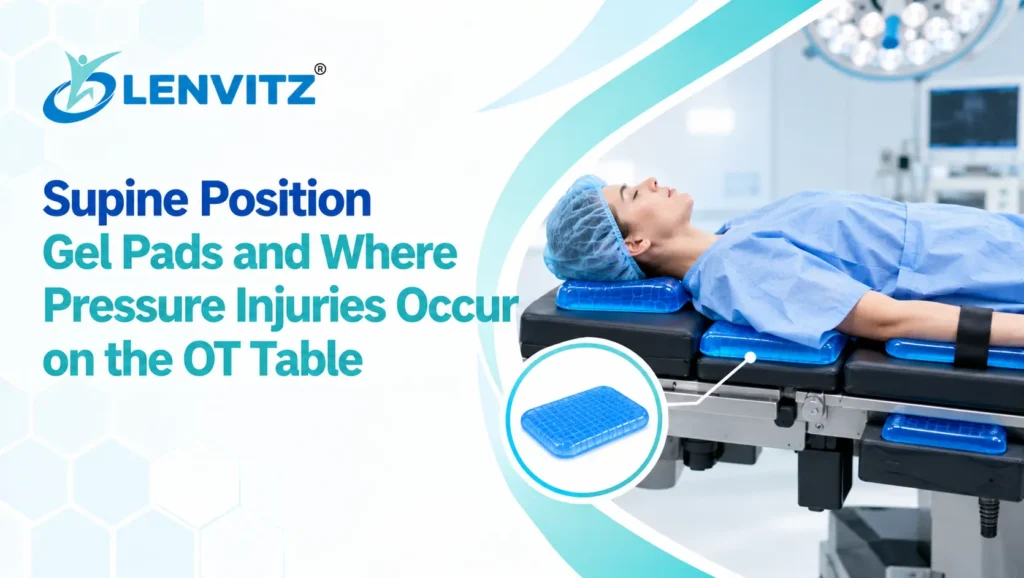
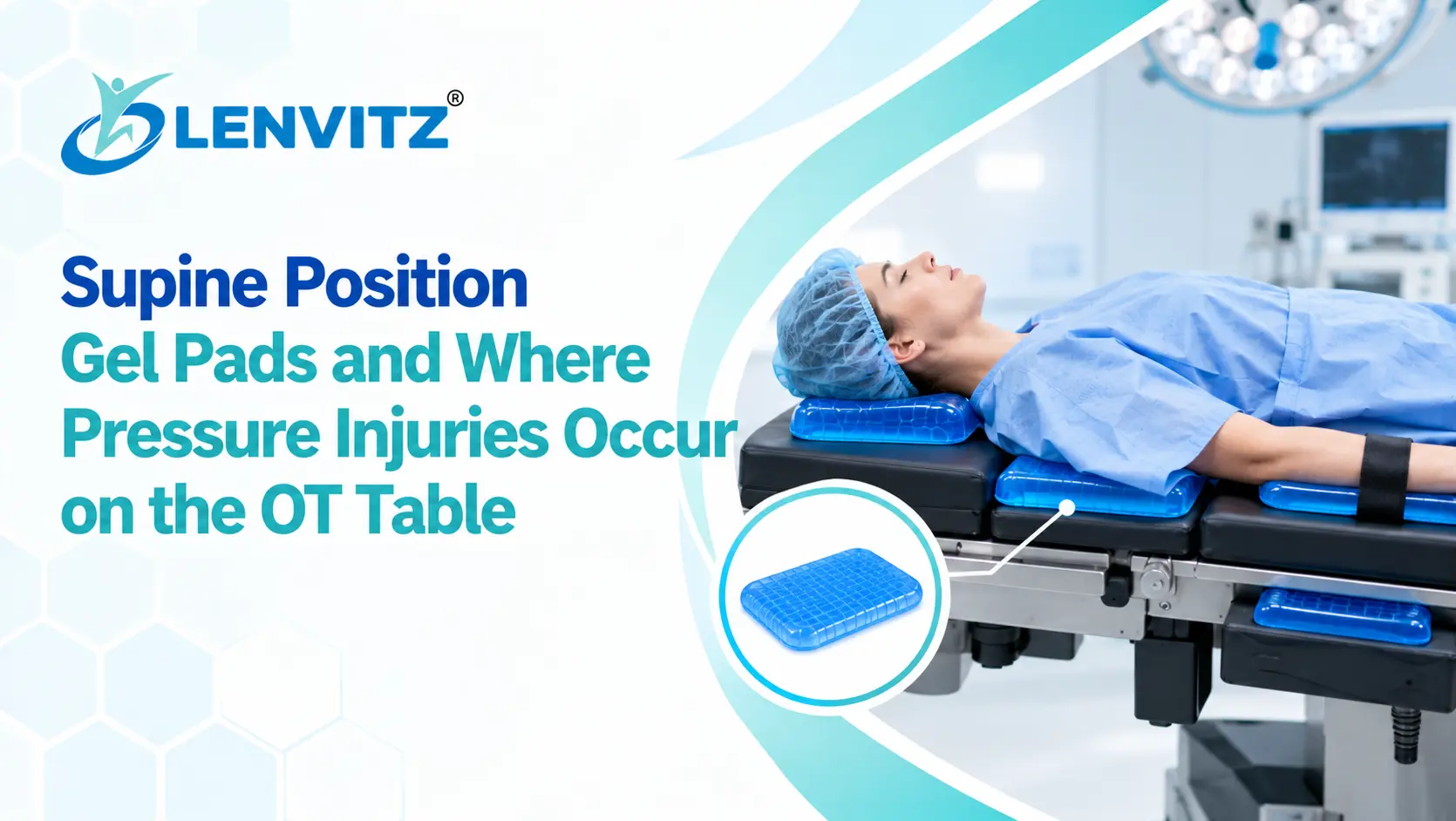
Pressure injuries on the OT table cluster in a few predictable places. In the supine position they form under the back of the head, shoulder blades, elbows, sacrum and heels. Lithotomy adds more strain on the sacrum and heels and puts the nerves around the knee at risk. Supine position gel pads placed under these points before draping spread the load over a wider area and reduce shear, which is why they anchor most positioning plans.
This guide maps where injuries occur, explains why the operating table is such an unforgiving surface, and shows how supine and lithotomy gel pads fit into a prevention routine.
Why the OT table is a high-risk surface
An operating table is firm, narrow and flat. Add general anaesthesia and the patient cannot shift their weight, cannot feel pressure building and cannot ask anyone to move them. AORN guidance treats every perioperative patient as at risk because they lie immobile on a relatively hard surface and cannot sense pain, friction or shear.
Tissue damage starts faster than most teams expect. Research cited in an AORN publication shows a pressure injury can begin within minutes, because cells deform under load long before the skin changes colour. For anaesthesia lasting three hours or more, the same source advises floating the heels, protecting the sacrum with a prophylactic dressing and resting the head on a pressure-redistributing positioner.
The harm is also easy to miss. A deep tissue injury can surface in the days after surgery, long after the patient has left the theatre. The OT team rarely sees the result of a positioning decision, which is why prevention has to happen on the table.
Where pressure injuries occur in the supine position
Bony points carry the most load because very little soft tissue sits between bone and the table. In the supine position, five areas need attention.
| Body area | Why it is loaded | Typical protection |
| Occiput (back of head) | Full head weight on a small contact area | Gel head pad or ring |
| Scapulae (shoulder blades) | Bone presses directly on the table | Gel body table pad |
| Elbows and ulnar nerve | Edge of the arm board, nerve close to the surface | Gel armboard pad |
| Sacrum and coccyx | Carries a large share of body weight | Gel sacral pad, prophylactic dressing if high risk |
| Heels | Small bony area with almost no padding | Heel suspension, gel heel pad where suitable |
One Brazilian study of positioning injuries shows how this plays out. Among the surgical patients it followed, 37.7% developed a pressure injury linked to positioning, and about nine in ten of those were stage 1. The sacrum and both heels were the most frequent sites. Stage 1 means skin that stays red when pressed. Caught early it is manageable, but it tells you the same load could cause deeper damage in a longer case or a frailer patient. Local figures will differ, though the pattern of sites is consistent across the literature.
Heels are the hardest area to protect with padding alone. AORN advises lifting the heels off the surface with a suspension device and keeping the knees slightly flexed, about 5 to 10 degrees, so they do not hyperextend. A boot-style device that offloads the heel and spreads leg weight along the calf, without loading the Achilles tendon, is preferred over a flat pad or egg-crate foam.
The supine position also affects the brachial plexus and ulnar nerve, so arm position and elbow padding matter as much as skin protection.
What changes in the supine lithotomy position
Many gynaecological, urological and colorectal cases begin with the patient lying supine, then move into the supine lithotomy position once anaesthesia is established. The hips and knees flex, the legs rest in stirrups or boots, and the pelvis tilts. Weight shifts toward the sacrum and coccyx. If the table is tilted during the case, the patient can slide against the surface, which adds shear.
Perioperative sources list the occiput, the sacrum and coccyx, and the heels as the common pressure sites in lithotomy. A second group of risks involves nerves. Lithotomy compresses and stretches the peroneal and femoral nerves, and pressure behind the knee or against the outer leg is a known route to common peroneal injury.
Padding alone does not fix this. Legs should be raised and lowered together and slowly, supported along the calf rather than at the knee crease, and checked for pressure at every stirrup contact point once the final position is set.
Duration changes the picture too. Pressure and time work together, so a pad that is enough for a 40-minute procedure may fall short in a four-hour one. When a case runs long, plan to reassess the pressure points at set intervals instead of trusting the first setup, and tell the surgeon when a position needs to change so the check does not feel like an interruption.
How supine position gel pads reduce pressure
Gel behaves like a thick fluid under load. It flows around bony contours and increases the contact area, so the same body weight is spread across more tissue. The practical result is lower peak pressure and less shear at each bony point.
Silicone gel and memory gel are the two common formulations. Lenvitz Medical Solutions, a Pune manufacturer of gel positioning products, makes both and describes them as almost equally effective at relieving pressure. It also supplies gel and foam combinations that are easier to handle in the OT and lower in cost, and its gel products come in adult, paediatric and neonatal ranges.
In a supine case, pads typically go under the head, along the back, under the arms and under the sacrum, with a heel solution at the other end of the leg. They are a support surface, not a complete plan. AORN’s recommendations pair two measures: place patients on surfaces that redistribute pressure, and apply prophylactic dressings to the heels and sacrum in high-risk patients. Gel pads do the first job. They do not replace heel offloading, risk assessment or repeat checks.
Where lithotomy position gel pads fit
Lithotomy position gel pads cover three areas. A sacral pad sits under the pelvis to reduce load and slip on the sacrum and coccyx. Stirrup pads and boot liners protect the lower leg and heel from shear, and knee crutch covers cushion the point where the leg rests. A gel head pad and body table pad then protect the same occiput and back as in any supine case.
One caution applies. These pads reduce direct pressure at contact points, but they do not correct a leg that is rotated, over-flexed or resting against a stirrup post. Position the patient first, then pad, and check the contact points again once the legs are settled in the stirrups.
Choosing gel pads for your OT
Five checks help when you review a range or compare suppliers.
- Size range: a pad that is too small leaves bone loading its edges, and neonatal and paediatric patients need their own sizes.
- Material: silicone and memory gel are described as similarly effective, so weight, handling and budget can decide.
- Cleaning: pads must tolerate your hospital’s approved disinfectant between cases, so ask the manufacturer for cleaning guidance.
- Condition: retire pads that are torn, leaking, flattened or sticky, because a worn pad gives false reassurance.
- Fit: confirm the pads work with your table width, arm boards and stirrup boots.
A positioning check before incision
- Assess risk before the patient reaches the table. The Braden Scale falls short for perioperative patients, so use a tool built for surgery.
- Place gel pads on the table or under the patient before transfer, and smooth any wrinkles in the linen beneath them.
- Float the heels and set the knees at 5 to 10 degrees of flexion in supine cases.
- Recheck every pressure point after final positioning and after any table tilt, drape tension or arm movement.
- Document the pads and positions used and pass them on at handover, so the recovery team knows which areas to inspect.
Prevention starts with knowing the sites
Positioning injuries are predictable, which makes them preventable. Know the five supine points, add the lithotomy sites when the legs go into stirrups, and give each one a surface that spreads the load. If you are reviewing your OT’s range, Lenvitz Medical Solutions can advise on supine and lithotomy gel pad sizes and materials for your procedure mix.
FAQ’s
Supine position gel pads are gel-filled positioning pads placed under the head, back, arms, sacrum or heels of a patient lying face up on the OT table. They spread body weight over a larger area and reduce shear at bony points.
The common sites are the occiput, shoulder blades, elbows, sacrum and coccyx, and heels. In the Brazilian positioning study cited above, the sacrum and both heels were the most frequent sites.
The supine lithotomy position has the patient lying on their back with hips and knees flexed and the legs supported in stirrups or boots. Teams use it for many gynaecological, urological and colorectal procedures.
The occiput, the sacrum and coccyx, and the heels carry the most pressure. The peroneal and femoral nerves are also at risk, especially when the leg presses against a stirrup post or the back of the knee.
Lithotomy position gel pads protect the sacrum, cushion the knee crutch, and line stirrups or boots to reduce shear on the lower leg and heel. A gel head pad and body table pad protect the occiput and back as in any supine case.