Tailbone pain is one of those conditions that sounds minor until you are living with it. Sitting at a desk for eight hours, taking a three-hour train journey, or recovering from a coccygectomy – every seated minute becomes a negotiation with pain. The coccyx, the small triangular bone at the base of the spine, bears enormous compressive load during sitting, and when it is injured, inflamed, or surgically compromised, that load translates directly into sharp, localised pain that disrupts work, travel, sleep, and rehabilitation.
A coccydynia cushion is the most consistently effective non-pharmacological intervention for managing this pain across all daily settings. Unlike general seat padding, a purpose-designed coccydynia cushion offloads the coccyx entirely – creating a pressure-free zone precisely where the bone contacts the seat surface. For anyone managing tailbone pain in India’s long office hours, congested public transport, or post-surgical recovery protocols, understanding which type of gel cushion to use, when, and why is the difference between enduring pain and genuinely managing it.
Why the Coccyx Is So Vulnerable to Sustained Pressure
The coccyx sits at the very bottom of the sacrum and acts as a stress-concentrating anchor point for several muscles and ligaments of the pelvic floor. In the upright seated position, it does not bear weight directly – but when posture collapses, the seat surface angles, or the chair is too hard, the coccyx makes direct contact with whatever surface is beneath it.
The common causes of coccydynia include:
- Trauma – A fall onto a hard surface, a direct blow, or a difficult childbirth delivery that fractures or displaces the coccyx
- Repetitive microtrauma – Cycling, rowing, or prolonged sitting on hard surfaces that creates cumulative stress on the coccygeal joints
- Post-surgical recovery – Coccygectomy or pelvic floor procedures leave the area acutely sensitive to any contact pressure
- Idiopathic coccydynia – Pain with no identifiable injury, often related to hypermobility of the coccygeal joint or referred sacral nerve pain
- Postpartum coccydynia – Hormonal loosening of pelvic ligaments during pregnancy combined with delivery trauma is one of the most common causes in Indian women aged 25–40
Understanding how a coccydynia cushion supports your spine and soothes tailbone pain begins with recognising that the coccyx injury itself is rarely the only problem – it is the sustained daily pressure that perpetuates it.
What Makes a Gel Cushion Different from Regular Seat Padding
Before looking at specific use cases, it is important to understand why material choice matters so much for coccydynia management. A gel cushion is not simply a softer seat, it is a pressure redistribution device that behaves fundamentally differently from foam, memory foam, or standard rubber padding.
The key material differences:
- Standard foam compresses under sustained load and bottoms out – the protective gap disappears within 30–60 minutes, leaving the user effectively sitting on the seat itself
- Memory foam responds to heat and pressure but has poor recovery time – once compressed, it stays compressed, meaning pressure relief degrades significantly over a long sitting session
- Medical-grade silicone gel flows and redistributes under load without compressing permanently. It continuously adjusts to micro-movements of the pelvis, maintains its pressure-relieving properties throughout the entire sitting session, and returns to its original shape reliably after each use
This is why silicon gel pads are the clinical standard for pressure injury prevention. Reading about medical gel cushions vs regular cushions explains this distinction in full detail.
Coccydynia Cushions Across Three Settings
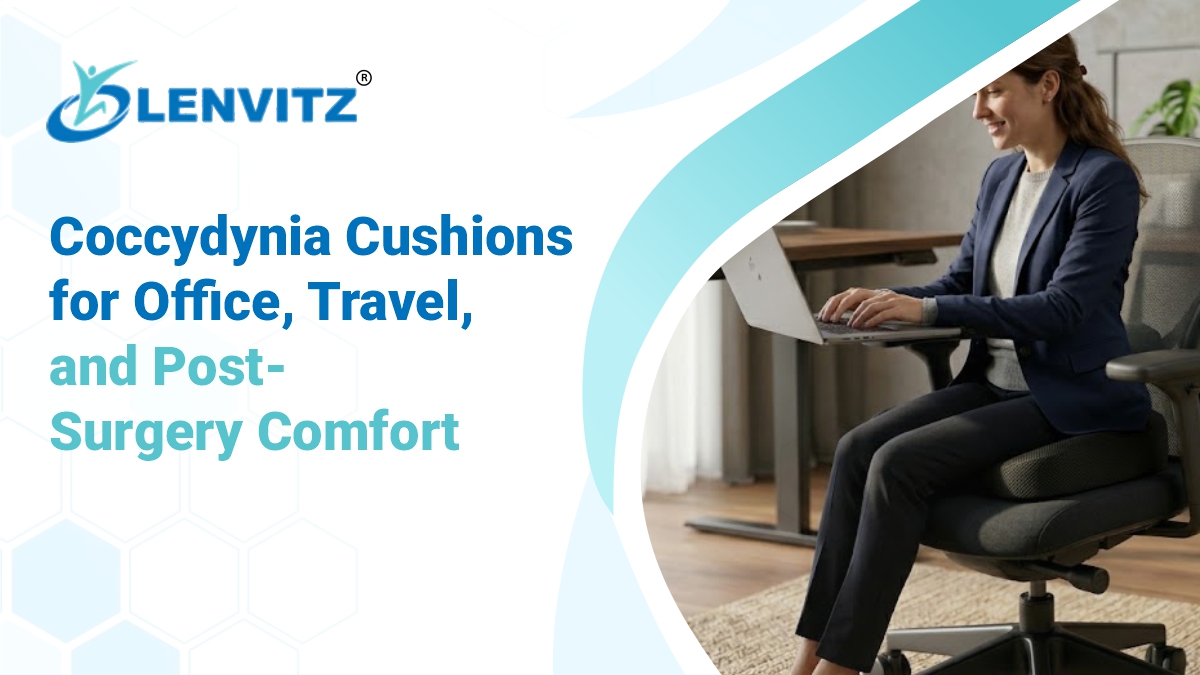
1. Office Use – Managing Tailbone Pain Through an 8-Hour Workday
The modern Indian office environment presents a specific challenge for coccydynia patients. Hard plastic chairs, fixed-height desks, continuous video calls, and compressed lunch breaks mean the average knowledge worker sits for 6–9 hours with minimal position change. For someone with an untreated or recovering coccyx injury, this is clinically equivalent to sustained tissue compression without relief.
What the right gel cushion does for office use:
- Offloads the coccyx with a U-shaped or coccyx cutout design – The posterior cutout removes all contact pressure, allowing the ischial tuberosities to bear the seated load instead
- Supports lumbar lordosis – A well-designed coccydynia cushion provides gentle anterior pelvic tilt, preserving the natural lumbar curve
- Maintains pressure relief throughout the day – Unlike foam alternatives, silicon gel pads do not bottom out over a long shift
- Non-slip base – Prevents the cushion from migrating on office chairs, a practical safety concern for users who shift position frequently
Practical recommendations for Indian office users:
Many Indian office environments still use hard plastic stacking chairs in meeting rooms or reception areas. Keep a portable gel cushion that moves with you across the desk, meeting room, and commute. Confirm the cushion’s dimensions match standard office chair seat depths (typically 40–45 cm) and that it has a removable, washable cover for daily hygiene.
2. Travel – Coccydynia Relief on Long Journeys
India’s travel culture involves long-haul distances across trains, buses, and aircraft where seat quality, legroom, and posture support are entirely outside the passenger’s control. For a coccydynia patient, a six-hour Shatabdi journey or a domestic flight is a genuine medical challenge, not just a comfort inconvenience.
The specific travel challenges for coccydynia patients:
- Hard, contoured aircraft and train seats that position the pelvis in retroversion, tilting the coccyx directly onto the seat surface
- No ability to stand or reposition during takeoff, landing, or between stations
- Vibration on road and rail travel that transmits directly to the sacrococcygeal joint
- Duration unpredictability – delays extend sitting time well beyond the planned schedule
What to look for in a travel gel cushion:
A travel coccydynia cushion must balance effective pressure offloading with portability. Key features include a compact profile that fits into a cabin bag or backpack, lightweight silicon gel pads construction, and a durable, wipe-clean cover that holds up to airport handling and varied seating surfaces. For long-distance train travellers on sleeper services, a gel cushion also supports sitting posture during meal times and while using the onboard seating.
3. Post-Surgery Recovery – Protecting the Coccyx After Pelvic and Spinal Procedures
The post-surgical context is where gel pads and coccydynia cushions move from comfort aids to clinical necessities. Following coccygectomy, spinal decompression, pelvic floor repair, or haemorrhoidectomy, the perineal and sacrococcygeal region is acutely sensitive and any direct pressure contact can disrupt healing, cause wound dehiscence, or create significant breakthrough pain that compromises rehabilitation compliance.
Primary post-surgical applications:
- Post-coccygectomy recovery – After surgical removal of the coccyx, a coccydynia cushion with a large posterior cutout ensures no surface contact with the surgical site during sitting rehabilitation
- Post-haemorrhoidectomy and anorectal surgery – Gel cushions with both anterior and posterior relief cutouts protect the entire perineal area during the 4–6 week recovery window
- Spinal fusion and laminectomy recovery – A gel cushion enables progressive rehabilitation to begin earlier and with greater comfort, improving physiotherapy compliance
- Postpartum recovery with coccyx trauma – New mothers with delivery-related coccyx fractures need pressure-offloading support from the first days of sitting and nursing
Understanding the top 5 features to look for when choosing a coccydynia cushion is especially important in the post-surgical context, where the wrong cushion can directly extend recovery time.
Why silicon gel pads are the clinical standard for post-surgical use:
Foam cushions degrade under the consistent daily demands of a post-surgical patient. Medical-grade silicon gel pads maintain their properties across extended use, can be disinfected between sessions, and provide dynamic pressure redistribution that static foam cannot. For post-surgical patients in Indian hospitals and home recovery settings, this durability is not a luxury – it is a basic requirement for safe rehabilitation.
Choosing the Right Coccydynia Cushion: Quick Reference
| Setting | Recommended Cushion Type | Key Feature to Confirm |
|---|---|---|
| Office (full workday) | Coccydynia Cushion – U-shaped Gel Cushion | Non-slip base, full-day pressure retention |
| Travel (train/flight) | Portable Gel Cushion with carry cover | Compact size, wipe-clean cover, solid silicone |
| Post-surgery recovery | Coccydynia Cushion with wide posterior cutout | ISO 10993 certified silicone, disinfection-compatible |
| Postpartum coccydynia | Gel Cushion with full perineal relief | Anterior + posterior cutout, washable cover |
| Long-term chronic coccydynia | Silicon Gel Pads – high-density medical grade | No bottoming-out, sustained daily use rated |
A Checklist for Indian Patients and Caregivers
Before purchasing or recommending a coccydynia cushion, confirm:
- The cushion uses medical-grade silicone, not foam or foam-gel composite – look for ISO 10993 biocompatibility certification
- The coccyx cutout is large enough to fully offload the coccygeal contact point, not merely reduce it
- The cover is removable, machine-washable, and fast-drying – essential for Indian humidity and daily hygiene
- The cushion dimensions are compatible with the primary use case (office chair depth, airline seat width, hospital bed sitting position)
- For post-surgical use, confirm the cushion can withstand IPA or clinical surface disinfection without material degradation
- Paediatric and smaller adult sizes are considered for postpartum patients or patients with smaller body frames
The broader context of how gel pads support pressure redistribution across the body is covered in medical-grade gel pads: superior comfort and support for various applications.
The Indian Context
Coccydynia is significantly underdiagnosed in India. Many patients attribute tailbone pain to generalised back pain, sciatica, or ‘sitting too long’ and manage it with oral analgesics rather than addressing the direct pressure mechanism. Physiotherapists, orthopaedic surgeons, and gynaecologists across Indian cities are increasingly recognising the condition, but the gap between diagnosis and appropriate seating support remains wide.
Indian workplaces, hospitals, and long-distance transport operators rarely provide specialised seating support as standard. Many low-cost options marketed as ‘coccyx cushions’ online are standard foam products with a token cutout, offering no sustained pressure relief. Medical-grade silicon gel pads from certified manufacturers are the standard that patients and clinicians should insist on.
Frequently Asked Questions
A gel cushion does not cure the underlying condition – it offloads pressure to prevent aggravation and allow the injury to heal without repeated traumatisation. For acute injuries, consistent use of a coccydynia cushion combined with physiotherapy and, where required, medical management typically produces significant improvement over 8–12 weeks.
Medical-grade silicon gel pads do not bottom out or degrade with normal daily use the way foam products do. A well-made silicone coccydynia cushion typically lasts 3–5 years with proper care, making the higher upfront cost significantly more economical than repeatedly replacing foam alternatives.
This depends on the surgery type and the surgeon’s guidance. For coccygectomy and most anorectal procedures, a gel cushion with an appropriate cutout is typically introduced within the first 48–72 hours of mobilisation. Always confirm with the surgical team before introducing any seating aid in the immediate post-operative period.
Yes, a non-slip base design ensures the cushion stays stable on office chairs, car seats, airline seats, train seats, and hospital chairs. The portable form factor of gel pads-based coccydynia cushions is one of their primary clinical advantages for patients whose daily lives span multiple seating environments.
A donut cushion offloads the entire central base of the pelvis in a ring. A coccydynia cushion with a U-shaped or posterior cutout specifically offloads the coccyx while maintaining ischial tuberosity support, preserving proper pelvic alignment and lumbar lordosis. For true coccydynia, the targeted design of a coccydynia cushion is clinically superior to a generic donut.